This week I went to a day-long workshop on sleep, sponsored by BYU. It was for regular people like me but also for therapists and other types of counselors. Since I have been dealing with some insomnia for the past 7-8 years, I was very interested in attending and learning more about it. It was free for me as a spouse of a BYU employee.
The presenter was
Dr. Wendy Troxel who is a psychologist who is a behavioral sleep medicine specialist. The workshop started out talking about all the reasons our body needs to sleep and what happens when we don't. Many of us there already have a great desire to sleep, if only we could get more of it.
She does not recommend any sleep aids at all, although she did say that if someone is not getting any sleep, sleep aids may be necessary in the short term.
The two components of going to sleep are your sleep drive and your circadian rhythm. It's easier to sleep when you haven't slept recently which is your sleep drive. It's easier to sleep at nighttime which is the circadian rhythm component. Your body produces hormones related to each of those.
She said melatonin should not be used as a sleep aid but should really only be used for shift workers and jet lag and be taken several hours before you want to sleep. You should also take no more than 3mg at a time, ideally less, down to .5mg.
She talked about good sleep hygiene:
To help lock in your circadian rhythm and feel more awake in the morning she recommends a wind-up routine. She personally takes a cold shower in the morning (as horrible as that sounds) and says it reduces inflammation. She says most people do not wake up feeling perky and ready to go. Most of us have to work at it. She recommends a lamp for the winter time when the sun doesn't rise until late in the morning.
It's very important to get out of bed if you're not sleeping so your body is trained to think BED=SLEEP.
People with insomnia should completely avoid naps.
She is a big advocate for pushing back school start times so teens can get the sleep they need. I don't see it happening at our local high school any time soon. However, you can use online school courses to give your child more flexibility with waking up in the morning.
She talked about how much sleep we need at different ages:
She talked about how insomnia is not the same as sleep deprivation. Insomnia means you have ample opportunity for sleeping but lack the ability to sleep enough.
Lots of people suffer from insomnia.
Insomnia and mental health really affect each other.
Something she clarified is that insomnia is having trouble going to sleep and/or having trouble staying asleep. I don't usually have trouble going to sleep, but I do struggle with staying asleep. I'll typically wake up after 5-6 hours of sleep and not be able to go back to sleep. She said you don't need to do a sleep study to treat insomnia unless you need to rule out some other sleep disorder--like sleep apnea.
She clarified that just teaching someone good sleep hygiene is not the same as effective behavioral treatment for insomnia. She recommends cognitive behavior therapy for insomnia.
Since finding practitioners for Cognitive Behavioral treatments for insomnia can be difficult, they have developed a mini-course on how to treat it. The first step is to teach them about sleep regulation.
The second step is to keep a sleep-wake diary:
Based on the sleep diary, you figure out how much time the person actually sleeps divided by the time they spend in bed which equals their sleep efficiency. You're aiming for over 90% sleep efficiency.
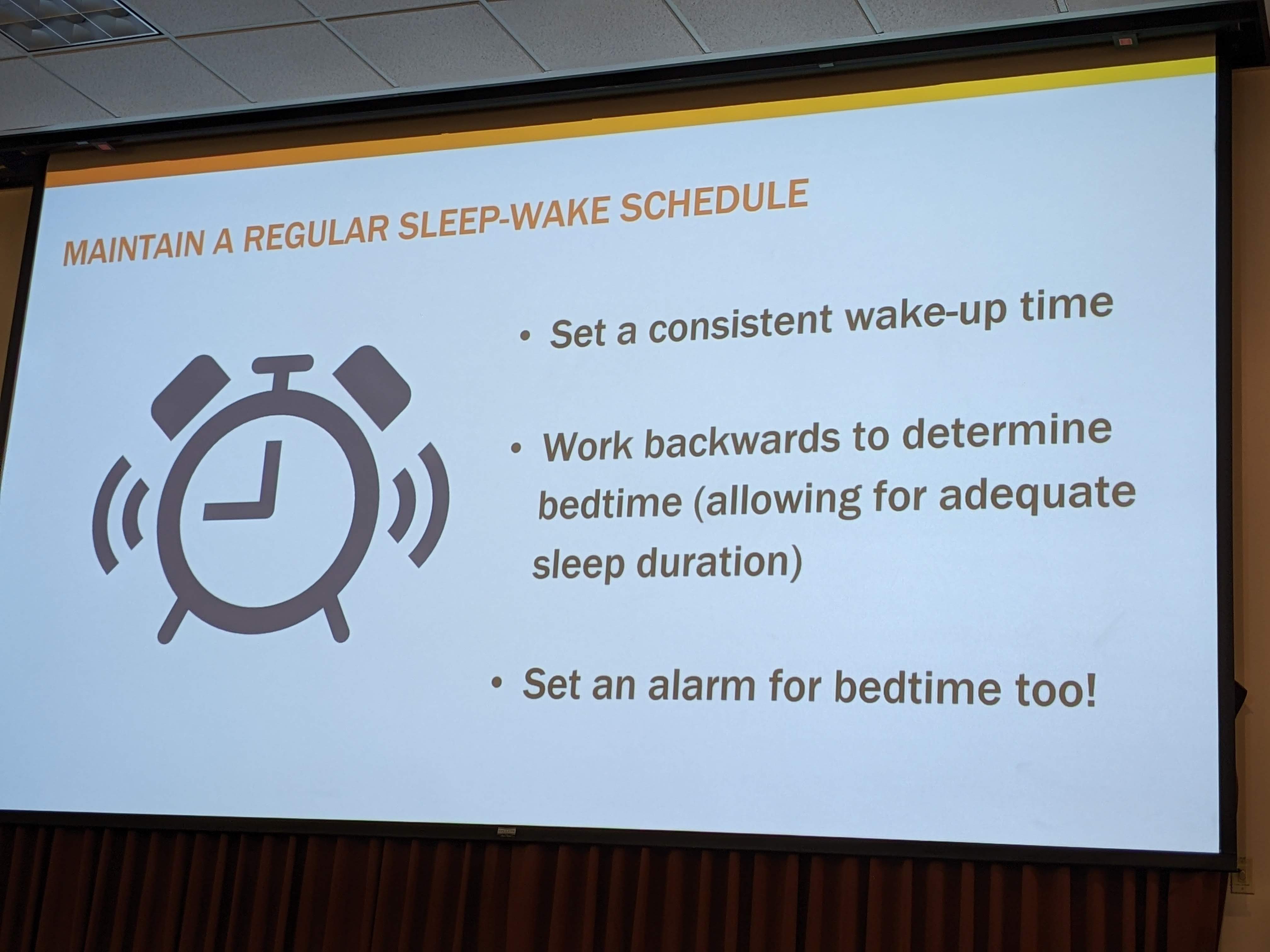
Based on how much time the person is sleeping, you establish your wake-up time and then work backwards to figure out your bedtime, adding in 30 min. leeway. The tricky part is that the person has to get up at the same time EVERY SINGLE DAY, even on weekends.
If you want to wake up at 6am every day and you sleep perhaps 6 hours a night, then you are going to go to bed at 11:30pm. Once you're sleeping well (more than 90% efficiency) every night, then you can go to bed 15 minutes earlier. The one caveat is that you don't spend less than 6 hours in bed. This is the mistake I made when I tried this method several years ago. I was spending less than 6 hours in bed and I was so tired that I was completely miserable and gave up.
The hard part is being consistent at all the rules.
In waiting to go to bed until you're sleepy, you should be careful not to miss that window. Sometimes people will wait too long and catch their "second wind."
More rules: no cell phones in the bedroom. Don't look at it in the middle of the night. Try not to look at the clock either, even when you're tracking your sleep.




Comments
Post a Comment